I have only a few superstitions. One has to do with traveling. I must wear my flying outfit (leggings, knit dress, flats, and old, dirty, super soft cashmere scarf with a dozen holes in it) for every flight and be in possession of my travel journal (the second volume). These have been my apotropaic objects. One of my favorite topics in art history, apotropaic objects are thought to protect from danger or bring good luck and are found in many diverse cultures.
I've become more flexible in the past few years since I've been traveling more than ever. On a return flight from Barcelona I dared to wear a comfortable silk dress with my new Spanish sandals. And I survived! Now I make a point to wear high heels whenever I fly. Might as well feel glamorous and trick people into thinking I'm a celebrity. It's the blonde hair.
Over the summer I saw lots of apotropaics, especially in Greece and Turkey. The evil eye! In both countries everyone was wearing these blue eyes as charms and I too began to wear one.
 |
| Follow the nazar! Ataturk airport, Istanbul, Turkey |
When we arrived at the airport in Istanbul one of the first things I noticed was a huge neon lit sign hanging from the ceiling with just the eye (nazar). At the entrance to nearly every shop or residence you see an eye. I began build my own collection of these protective objects as we traveled. Now I can't leave home without one of my eyes, a necklace with a mother of pearl eye inlaid with a turquoise stone. Since I got the necklace in Greece, it also has a cross on it.
I believe that my ever growing assortment not only kept us safe on all thirteen of our flights, but also got us into first class on our way to Stockholm.
 |
| Alex shows off his own eye on Turkish Airlines. |
 |
| First class space Istanbul to Stockholm! Note the old, dirty apotropaic cashmere scarf full of holes. |
Recent additions to my collection include this rad double bear necklace. I spotted it back in October when we were in Schulenburg (the Eastern/Northern European settled part of Texas), but I didn't allow myself to take it home with me.
It reminds me of the bears climbing the walls of the Czechoslovakian Krumlov Castle. I was surprised to find it under the Christmas tree and I've been wearing it religiously ever since. Thank you darling Alex!
 |
| Bear moat at the Český Krumlov Castle, southern Czech Republic. The castle was originally built in the 13th c., the tower is a Gothic era addition. Bears have been kept at the castle since 1707. |
 Kateřina and Vok (mother and son) play in the courtyard.
And then we went to NEW MEXICO!
(the eye and bears accompanied us). The trip coincided with the beginning of 2013 and while we were there the number 13 kept popping up, several times in mundane, but telling ways. We've decided that this is our protective, lucky number.
 |
| This was taken on our last day in NM. After encountering the number 13 several times already, I decided I should finally document. We were sitting at the counter of the fantastic Plaza Cafe (Santa Fe's oldest restaurant) facing this. I also had the most delicious tres leches cake there. |
But I want to talk more about the strong presence of apotropaic objects in the Southwest, a place which of course is historically a combination of Native American and Mexican culture. In Santa Fe I saw lots of
milagros (literal Spanish translation: miracles, which are borne out through Mexican protective charms). These are typically forms of body parts pressed in tin. Basically if you need help with your arms, legs, heart, intestines, fertility, eyes (general protection), you carry a charm in the relative shape. Sometimes these charms are added to religious works of art as holy offerings.
 |
| Milagros at the International Museum of Folk Art in Santa Fe, NM. |
Although these kinds of pressed charms are numerous in Mexico and Latin America, there are counterparts in many parts of the world. The first time I saw them in person was last summer in Greece. There they are called
tamatas and are often found heavily clustered around icon paintings in churches.
 |
| Tamatas hang beneath an icon painting at one of the many Cycladic Island churches we visited. |
Guess what? I'm obsessed. In Santa Fe, among lots of Mexican
milagros, I found one of these Greek charms, almost exactly like the one of the eyes on the top right. It's from the WWII era and it's the first to enter our collection. The next day we went out to the
Museum of International Folk Art. The website is a little outdated, but the museum is one of the best ever. It's the first international folk art museum in the world! Started by a woman who had lived through both world wars, it was meant to promote an understanding between cultures. This is still a relevant and needed effort.
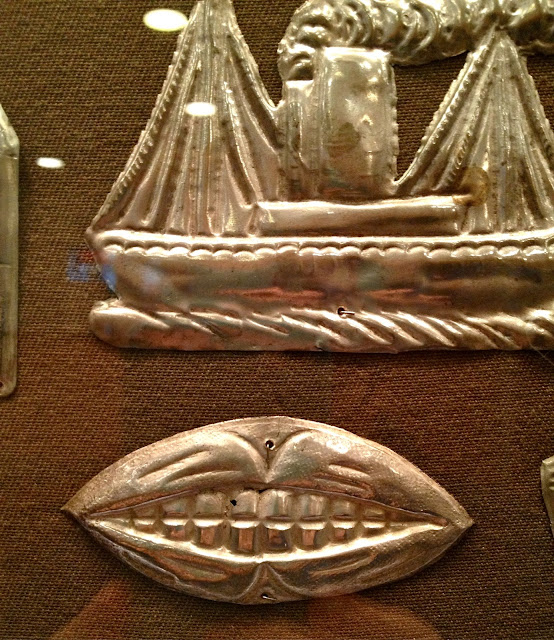
My favorite was Alexander Girard's collection, "Multiple Visions: A Common Bond." There are no wall labels to interrupt the experience, which I think is great. The galleries are filled with lovingly arranged dioramas and the best way to be delighted is by taking it all in visually, letting your eyes catch on the sublime details. You can follow the guide books stacked up at the entrance if you'd like a bit of information.
Eyes are pretty universal and SO INTERESTING! I still want to write a book on eyes in art history. For now, please enjoy my documentation of these stunning works (which are mounted on silk!).
 |
| Girard's collection of milagros, votives, nazars, and tamatas from all over the world. I love it! |
 |
| Italy. |
 |
| India. |
 |
| Wax votives from Italy. |
 |
| Turkey (vintage nazar!). |
 |
| Syria. |
 |
| Italy. |
 |
| Italy. |
 |
| Morocco. |
After drooling over these, we found little treasure shops and picked up a few more votives and milagros. We scored a vintage silver arm from Italy, a Mexican heart, and a tin hand. My one regret is that I didn't pick up a dream catcher. These seem to be the Native American protective gear. The only reason I didn't get one is because Alex claims that we need bad dreams as much as we need good dreams and I guess I agree. I did get some silver eagle feathers and vintage turquoise. These are also important to the Native American culture.
I can't wait to set up my little collection of charms and amulets and I definitely know I'll be looking out for more on future travels.
Coincidentally, this call for papers blurb popped up in my e-mail yesterday..."What work did objects do in medieval culture? What made an object efficacious? Art historians have begun to take seriously objects, including amulets, talismans, ex-votos, funerary effigies, astrolabes, eye glasses, decorative armaments, furniture, textiles, as well as the sacraments of the Christian church and a wide range of medieval counterfeits, that raise important questions of agency, efficacy, and authority." Sounds amazing. Too bad the deadline is next Tuesday.
More details on why New Mexico is so awesome: next time!