Showing posts with label Film. Show all posts

1.21.2014

Get Your Mind Going

Hungry for something deeply provocative? Here is a double feature that spontaneously unfolded over this weekend.

My original double feature, one I had been inexplicably imaging for many, many years, was meant to be Klute and Krull. I don't know what propelled this set other than the strange sounding one word titles. We'd already had a look at Klute and left it unimpressed half way through. When Krull arrived shortly thereafter I had somewhat reduced hopes. It lasted about five minutes in the machine. Out out!

In place of my failed programming we agreed, at around 10pm Saturday evening, to fire up last year's The Act of Killing. This documentary, conceived of and directed by (Texas born) Joshua Oppenheimer, was shocking in the vein of Herzog. I was not expecting to empathize with the antagonists re-enacting, cinematically, their sordid exploits in Indonesia during the 1960s.

The Act of Killing, 2012. 


Throughout the film, I must say, we were wracked with questions and discomfort. Without going into a needless review: I recommend this film for those of you interested in the incredible. The concept, production, and resultant dialogue are reminders of the power of visual arts, human connections, and the problems therein.


Despite the fact that we were a little shaken and perplexed by the unfolding events in the film we drifted off to sleep without any soft chaser. I'm surprised that I was able to do so easily.  

A last minute decision the following day to attend Slavoj Zizek's The Pervert's Guide to Ideology, along with a mob of other Houstonians, gave us the critical language for framing and understanding The Act of Killing. Throughout this film I kept getting antsy to share with Alex the connections that could be made (beyond the fact that both films use cinema, implicating themselves as characters superimposed or unseen, as a vehicle for advancing particular ideas).


For an out-of-academia academic Zizek's vitality for applying complicated theories to pop culture and relating them contextually is a life giving nutrient. Of course there were plenty of arguments that were completely lost on me, but during two thrilling hours there was plenty of activity among my brain cells. So many of his ideas and comments are in line with my underdeveloped ranting sentiments, especially consumerism and desire. I especially appreciated his take on the stupid film, Titanic.

Still from They Live.


After Zizek relented with his manic mad genius charisma we went straight toward the booze for an extended discussion, this time including a couple of our friends from the MFAH's conservation lab (and oddly enough we ran into another couple of conservation colleagues at the bar).  

All of this, along with a caffeine jolt picked up at the Kafeneio (Nescafe Frappe!), got me buzzing with excitement. The complicated feelings unearthed from watching the documentary, heightened by the rapid fire, wide ranging knowledge and theoretical lingo from Zizek, has me feeling quite alive and well. When I worry about my critical mind, my unanswerable questions, I will think of Zizek and be comforted.


11.29.2012

Themes In Art: Farmers, Japanese and Newly-Texan Moravians.

One thread connecting two seemingly disparate stories. Just go with it.

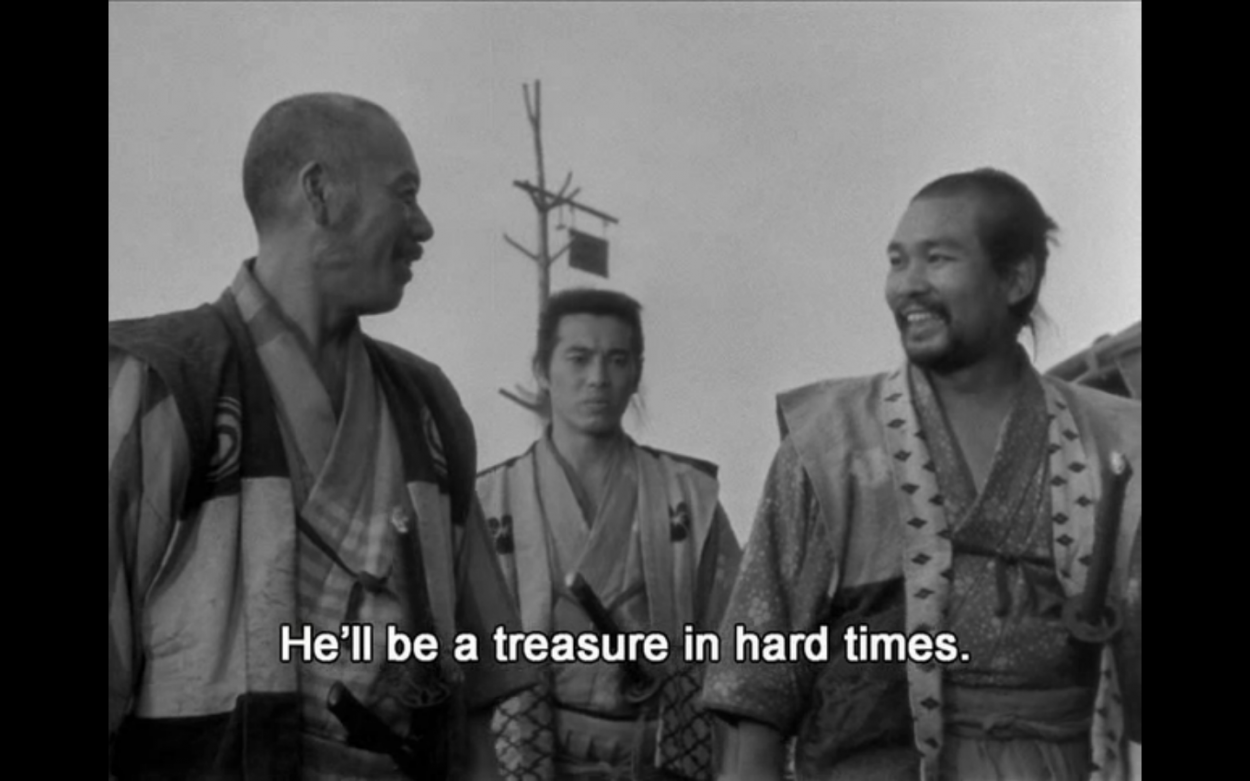
I've been thinking about block printing lately and our recent viewing of Kurosawa's Seven Samurai, which is AWESOME, gave me lots to get excited about. The story centers on a community of farmers and a collection of samurai. Viewing of the three hour masterpiece spanned the entire weekend. Lingering thoughts on the film and its characters were interspersed with a road trip out of town and into Texan farmland.

We took a day trip to the Northern European part of Texas, 90 miles west of Houston, where immigrants from Germany and the Czech Republic (formerly Moravia) settled, fleeing the Austrian Empire. Our main agenda was to take a tour of the "painted churches." These are turn of the century farm churches, often far from the next town. Though the exteriors are simple and the surroundings, farmland, the interiors are exploding with color and design.

Queen of the Painted Churches, St. Mary's at High Hill.


St. Mary's Church of the Assumption, Praha, Texas.

I'm really into these panels framed with flora, but completely absent of fauna. I know it's supposed to be paradise, but it seems post-apocalyptic. Stay tuned to see something similar from a synagogue in Venice.
Sts. Cyril and Methodius, Dubina, Texas. Built 1876, rebuilt 1912.
Inlaid marble cross leads the way to salvation.
Most of these churches have outdoor restrooms. This one is labeled in both English and Czech.

In Shulenburg we passed a Czech bakery. After a quick and excited turnaround we were in line staring at the variety of kolaches, basically a filled pastry. I've seen kolaches all over Houston, but they're notoriously non-vegetarian. However, I learned that the traditional kolache is filled with poppy seeds, sweet cheese, or fruit. 

Later that day while wandering around La Grange I spotted the Texas Quilt Museum. We had fun looking through the beautifully preserved 19th century building filled with all kinds of hand made quilts. Now I want to make a one like this antique paper cutting style. 


But back to the Samurai.

The plot in short: a village of farmers intend to keep safe from the bandit's harvest time plunder. Their strategy is to employ samurai, basically another enemy to intimidate and kill the roving bandits. The story is set in the 16th century, medieval! just the way I like it, and is gorgeously shot. There are so many wonderful things to say about Kurosawa's film (see Alex), but I want to focus on the Academy Award nominated costumes by Kohei Ezaki.

They're lovely. And full of fantastic prints. I'm always looking for the detail work in any art form and it's plentiful here. Kurosawa was known for considering historically accurate dress and I think it shows. You can really imagine the feel of these organic fibers, cotton, linen and silks, hand dyed with local plants, and stamped by hand with wood block prints.

Medieval era samurai, and some farmers, typically wore three garments: hakama, kimono, and kataginu.

Heavily pleated hakama on the left paired with printed kimono.
Kataginu, sleeveless jacket with bold shoulders.
Probably my favorite print, a bow and arrow feather repeat across the back of Kikuchiyo's kimono.

One shoulder off for combat.
These are some examples of what the bandits wore. 

Too many tragedies. 


11.11.2012

Sick-In-Bed Double Feature.

It's strange staying in bed during the day, but I need to combat my everlasting cold. I made the most out of it by playing two movies which seem to have quite a few things in common.

Number one: they both made me laugh my ass off. Good medicine, right?


Sacha Baron Cohen in Brüno, 2009

I have a crush on SBC, always have. He's amazing. Well educated, interested in religious and cultural affairs and current issues, unafraid of making the world uncomfortable for the sake of social progress. Also: incredibly funny. And good looking. And he speaks German in this one. Swooon Schatzi.


I love LOVE everything about this movie. How have I never seen this before? 


Louis CK's Pootie Tang, 2001

I especially love Wanda Sykes, as Biggie Shorty, giving her best Lady Miss Kier moves.


#2: Both lead characters, icons really, are true individuals. The attention to style and costume in these two movies is totally inspiring and satisfying.

#3: Both struggle against adversity, whether it's homophobia, xenophobia, malt liquor, or corporate America. I thought the gay conversion segment in Brüno was especially heartbreaking and the Pootie Tang PSA's encouraging healthy lifestyles, equally heartwarming. 

*too much information warning*
In Pootie Tang there's a small part played by an intense comedian poet I met at the Flea Theater in NYC and briefly dated. 

FINAL WORD: 
Watch these and be cured of all ills.

11.06.2012

Pre-Cinematic Bruegel.


Hunters in the Snow, Bruegel, 1565.

I'm consistently drawn to the expression of proto-cinematic movement in art that predates the motion picture. I'm always on the lookout for it and have seen examples in everything from prehistoric cave paintings to ancient Greek vessels to, as I argue, the Romanesque portal sculpture at Ripoll.

I pulled this from the Tufts Art History site:

Professor Martin Schulz, Academy of Arts, Karlsruhe, Germany, describes his lecture: "Animated and Animating Landscapes: Space Voyages and Time Travel in the Art of Pieter Bruegel the Elder."

"The lecture will explore the famous painting "Hunters in the Snow" by Pieter Bruegel the Elder. I will focus on the spatial effect of the landscape as an animation of the gaze and a translation of images through and across different media: from illumination via drawing to panel painting and finally, in a long leap ahead, to the immersive possibilities of film, video, and many digital based images.

I am going to argue Bruegel's landscape appears to have a pre-cinematic quality. The immersion of the gaze lends itself to a travel through time and space from the depictions of the months in the medieval books of hours up to the cinematic adaptation and transformation of the painting, as it was accomplished by Andrei Tarkovsky in his film "Solaris" from 1972. This leads to a crystalline compression of space and time, in which past and present, actual and virtual space, material and mental images, painting and film and, not least, technology and gaze permeate and determine each other."

Sounds like a very interesting paper. Space Travel!

6.21.2012

Getting Ready For Adventures: Tezuka Osamu's Jumping


I don't know too much about Tezuka Osamu, other than some theoretical academic stuff on his interest in ambivalent or hyper illustrations of gender. Tezuka, a Japanese animator, is known for using hermaphroditism and gender reversal in manga. 

I really like this short animation, though it doesn't deal with gender at all. It feels especially appropriate as we prepare to take off on a complex adventure, which will surely be filled with mundane events that, with surreal qualities and memorable imagery, should equal the conventional, glittering spectacles. 

2.11.2012

Building Character.

I've been thinking lately about my temporary or timely, depending on how you look at it, identity crisis. Before I moved to Cambridge and consequently activated my new academic persona I was completely comfortable and happy being slightly irreverent. Look! I'm in Philadelphia Magazine!
But this kind of fun colorful lifestyle was about to change.


Maybe it was the eight months of cold weather, maybe it was the twelve hour days in the library. I'm sure it was a combination of many things related to my new environment. My grounded sense of identity, as I had known it for so many years, began to quickly dissolve and mutate. There was nothing I could do to stop it. Before long I could relate to local eccentrics wearing shirts that said Danger: Re-Animated Corpse. It may sound insignificant or even dramatic, but it was difficult terrain and probably contributed to my gray days of malaise. 


At the beginning of the third semester I passed the comprehensive exams. High on success, I poured black dye over my head and starting wearing lipstick and nail polish. It was a small taste of liberation and it helped me unravel the stress uniform. However, I will say that the Cantabrigian look suits me quite well. Tweed, wool, menswear, wingtip oxfords, stripes, madras, plaid, neo-vintage nerd eyeglasses, J. Crew! These have all been happily absorbed into my wardrobe.

Now that I am beyond my grad school days, which ultimately turned out of course to be an immeasurable experience in the best sense, I have returned to the original (now with larger brain and tweed blazer!) fun-loving weirdo: me. That is worth celebrating! With new shoes probably. 

For a fresh breath of creative air see these gems. All of the women are incredible sources of inspiration. I especially love the Idiosyncratic Fashionistas. Instead of just telling you how to copy, they teach you how to have a great time and do it your own way. 


I get so excited about being expressive today, tomorrow, and forever though I still plan to dress monochromatically when I'm advanced. 

Yeah!

11.20.2011

Udo Kier! Madonna, But Really Melancholia.


Melencolia I, Albrecht Dürer, Engraving, 1514.
Dürer makes a comment on the superhuman artistic genius and the ephemerality of life.


Last night Orsi and I submitted ourselves to Melancholia, Lars von Trier's latest effort. The beginning reminded me of Matthew Barney, an artist that I don't particularly stomach well. Von Trier's slow motion tableaux were enchanting, to be sure, but the monumental scale and fantastical setting brought me back to my experience with the Cremaster Cycle, one of the only films that I have walked out on. Even during the first few minutes of Melancholia my anxiety levels were shooting up, that music (Wagner's Tristan und Isolde)! I wondered if I would have to make a fool of myself by running away from the oppressive sensory overload that was building and building. But then it skipped ahead to a long reception scene, though this inspired another kind of stress. Orsi and I agreed later that the frenetic, swiping camera work was nausea inducing: audience assault. Effective though, in setting the tone.

I won't say that I liked this film, but I didn't hate it either. I might categorize it as another challenging experience that is certainly a work of art, but not one that necessarily provokes contemplation beyond style. After fulfilling my pre-requisites by enduring Antichrist publicly in a movie theater last year, I suppose I'm inured and even expectant of a full body impact. In contrast to the startling scenes in Antichrist, Melancholia doesn't show graphic violence. During Antichrist I had to hide my eyes several times, even though the rest of the audience (slightly tipsy and inappropriately boisterous) seemed to be there to see the bits of sex and paid little attention to anything else.

Melancholia stylishly shows first the destruction of relationships and people and finally threatens all of us watching, with this looming apocalypse. The closing act seemed intent to annihilate the entire audience. Someone (not me!) has been reading too much Arthur Schopenhauer: fatalistic philosophy. Schopenhauer was a pessimistic German guy who basically said, life isn't worth it, just kill yourself. His philosophy seems to have been inspired by the tenets of Buddhism, especially the concept that desire of any kind leads only to suffering. Disentangling yourself from desire is the only way to achieve spiritual freedom. Since he was so pessimistic, his solution to this (though he did not himself commit the act), was to end the only life you have the right to end. It is his opinion that

"Suicide may also be regarded as an experiment — a question which man puts to Nature, trying to force her to an answer. The question is this: What change will death produce in a man’s existence and in his insight into the nature of things? It is a clumsy experiment to make; for it involves the destruction of the very consciousness which puts the question and awaits the answer." (from Studies on Pessimism, AS)

But, details. The way those luscious textiles draped over the leading ladies Kirsten Dunst, Charlotte Gainsbourg and Charlotte Rampling, was making me twitch with excitement. It was a treat watching them onscreen, especially frolicking in the Scandinavian woods. Oh magical birch trees! I also liked: the spectacular art library and the fleeting images used to support the state of things in the film. This Flemish painting was featured among others.

Bruegel’s Hunters in the Snow, 1565. Bruegel presents his winter landscape as the main subject. The figures, to the left and with their backs turned toward us, offer no indication of personal feelings.

Some of my favorite characters included the father, whom Orsi tells me is from the Harry Potter movies. I didn't even recognize him, but John Hurt adds a certain charismatic warmth as Justine's Stupid Dad. I also loved seeing Udo Kier as the wedding planner. I was first introduced to him through Madonna, in this classic video for Deeper and Deeper (from Erotica, 1992).


Of course Kier was already a star, having worked most notably with Warhol, Paul Morrissey, Fassbinder, and Dario Argento (Suspiria!). I want to know more people like Udo Kier. He is absolutely incredible. Is he even real?


Blood For Dracula, 1974.

And so, Melancholia: The whole does not equal the sum of its parts. I didn't mind too much though because we decamped to Hungry Mother for some marvelous conversation, drinks and dessert. Butterscotch Pot de Creme with White Pepper and Popcorn Brittle, if you want to know. It was the perfect accompaniment and antidote. 

I find myself thinking more about others things I saw recently. First, Breaking Bad. A television show about a man who enhances his dreary day job as a Chemistry teacher with a dangerous foray into the profitable art of cooking Meth- with a failed student. One strange thought that I had: what if a former student of mine became an art thief? Weird. Also: I highly recommend Terri (2011), written and directed by Azazel Jacobs. Quiet and understated, it left me wanting more and with plenty of questions. Alex had some interesting things to say about it.