One thread connecting two seemingly disparate stories. Just go with it.
I've been thinking about block printing lately and our recent viewing of Kurosawa's
Seven Samurai, which is AWESOME, gave me lots to get excited about. The story centers on a community of farmers and a collection of samurai. Viewing of the three hour masterpiece spanned the entire weekend. Lingering thoughts on the film and its characters were interspersed with a road trip out of town and into Texan farmland.
We took a day trip to the Northern European part of Texas, 90 miles west of Houston, where immigrants from Germany and the Czech Republic (formerly Moravia) settled, fleeing the Austrian Empire. Our main agenda was to take a tour of the "painted churches." These are turn of the century farm churches, often far from the next town. Though the exteriors are simple and the surroundings, farmland, the interiors are exploding with color and design.
 |
| Queen of the Painted Churches, St. Mary's at High Hill. |
 |
| St. Mary's Church of the Assumption, Praha, Texas. |
 |
I'm really into these panels framed with flora, but completely absent of fauna. I know it's supposed to be paradise, but it seems post-apocalyptic. Stay tuned to see something similar from a synagogue in Venice.
|
 |
| Sts. Cyril and Methodius, Dubina, Texas. Built 1876, rebuilt 1912. |
 |
| Inlaid marble cross leads the way to salvation. |
 |
| Most of these churches have outdoor restrooms. This one is labeled in both English and Czech. |
In Shulenburg we passed a Czech bakery. After a quick and excited turnaround we were in line staring at the variety of kolaches, basically a filled pastry. I've seen kolaches all over Houston, but they're notoriously non-vegetarian. However, I learned that the traditional kolache is filled with poppy seeds, sweet cheese, or fruit.
Later that day while wandering around La Grange I spotted the
Texas Quilt Museum. We had fun looking through the beautifully preserved 19th century building filled with all kinds of hand made quilts. Now I want to make a one like this antique paper cutting style.
But back to the Samurai.
The plot in short: a village of farmers intend to keep safe from the bandit's harvest time plunder. Their strategy is to employ samurai, basically another enemy to intimidate and kill the roving bandits. The story is set in the 16th century, medieval! just the way I like it, and is gorgeously shot. There are so many wonderful things to say about Kurosawa's film (
see Alex), but I want to focus on the Academy Award nominated costumes by Kohei Ezaki.
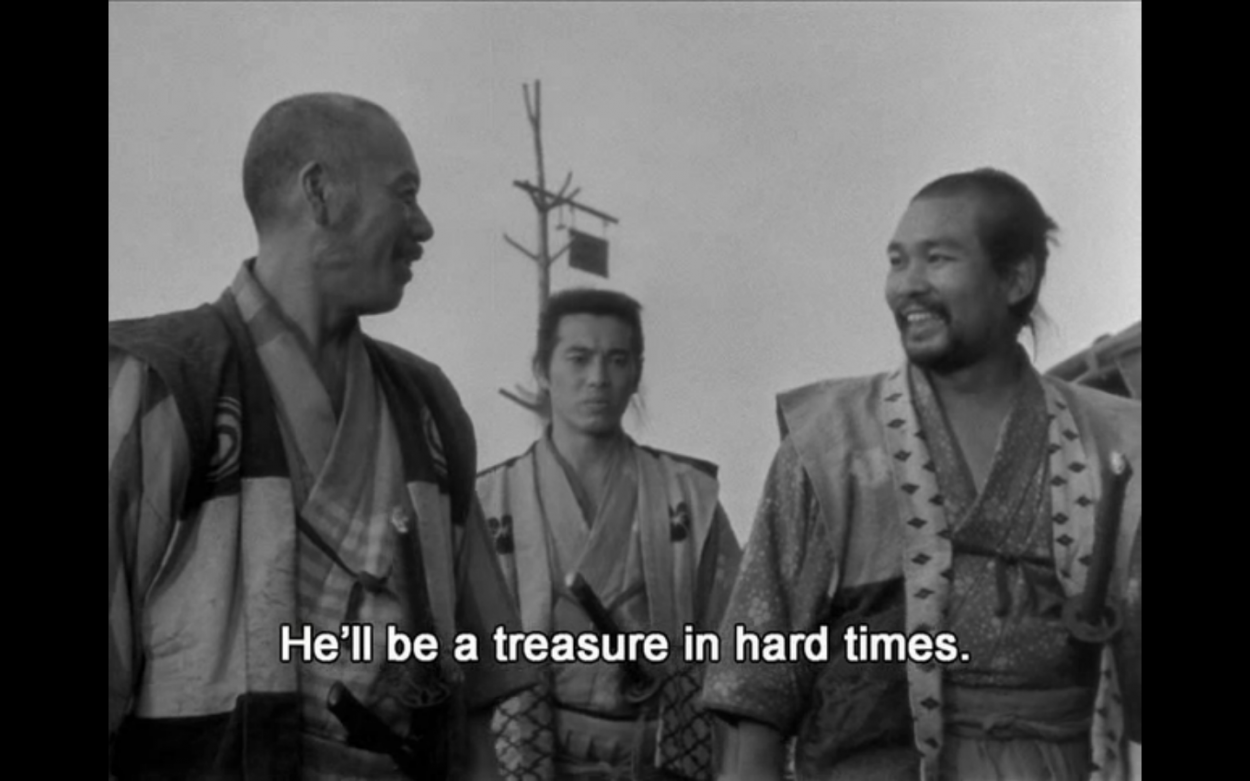
They're lovely. And full of fantastic prints. I'm always looking for the detail work in any art form and it's plentiful here. Kurosawa was known for considering historically accurate dress and I think it shows. You can really imagine the feel of these organic fibers, cotton, linen and silks, hand dyed with local plants, and stamped by hand with wood block prints.
Medieval era samurai, and some farmers, typically wore three garments:
hakama, kimono, and kataginu.
 |
Heavily pleated hakama on the left paired with printed kimono.
|
|
| Kataginu, sleeveless jacket with bold shoulders. |
|
 |
| Probably my favorite print, a bow and arrow feather repeat across the back of Kikuchiyo's kimono. |
 |
| One shoulder off for combat. |
 |
| These are some examples of what the bandits wore. |
 |
| Too many tragedies. |