

Showing posts with label Japan. Show all posts
Showing posts with label Japan. Show all posts
3.05.2013
Japanese Apotropaic Needlepoint


11.29.2012
Themes In Art: Farmers, Japanese and Newly-Texan Moravians.
One thread connecting two seemingly disparate stories. Just go with it.
I've been thinking about block printing lately and our recent viewing of Kurosawa's Seven Samurai, which is AWESOME, gave me lots to get excited about. The story centers on a community of farmers and a collection of samurai. Viewing of the three hour masterpiece spanned the entire weekend. Lingering thoughts on the film and its characters were interspersed with a road trip out of town and into Texan farmland.
We took a day trip to the Northern European part of Texas, 90 miles west of Houston, where immigrants from Germany and the Czech Republic (formerly Moravia) settled, fleeing the Austrian Empire. Our main agenda was to take a tour of the "painted churches." These are turn of the century farm churches, often far from the next town. Though the exteriors are simple and the surroundings, farmland, the interiors are exploding with color and design.


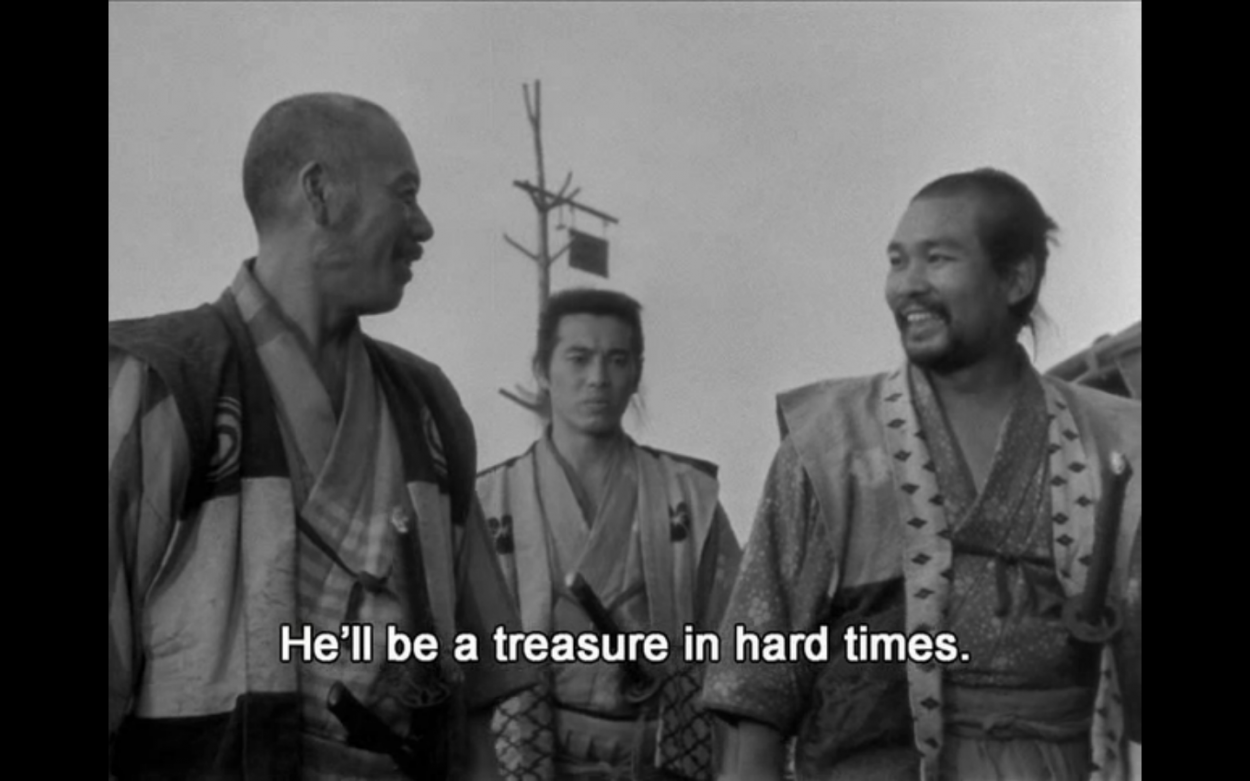
The plot in short: a village of farmers intend to keep safe from the bandit's harvest time plunder. Their strategy is to employ samurai, basically another enemy to intimidate and kill the roving bandits. The story is set in the 16th century, medieval! just the way I like it, and is gorgeously shot. There are so many wonderful things to say about Kurosawa's film (see Alex), but I want to focus on the Academy Award nominated costumes by Kohei Ezaki.
They're lovely. And full of fantastic prints. I'm always looking for the detail work in any art form and it's plentiful here. Kurosawa was known for considering historically accurate dress and I think it shows. You can really imagine the feel of these organic fibers, cotton, linen and silks, hand dyed with local plants, and stamped by hand with wood block prints.
Medieval era samurai, and some farmers, typically wore three garments: hakama, kimono, and kataginu.

I've been thinking about block printing lately and our recent viewing of Kurosawa's Seven Samurai, which is AWESOME, gave me lots to get excited about. The story centers on a community of farmers and a collection of samurai. Viewing of the three hour masterpiece spanned the entire weekend. Lingering thoughts on the film and its characters were interspersed with a road trip out of town and into Texan farmland.
We took a day trip to the Northern European part of Texas, 90 miles west of Houston, where immigrants from Germany and the Czech Republic (formerly Moravia) settled, fleeing the Austrian Empire. Our main agenda was to take a tour of the "painted churches." These are turn of the century farm churches, often far from the next town. Though the exteriors are simple and the surroundings, farmland, the interiors are exploding with color and design.
 |
| Queen of the Painted Churches, St. Mary's at High Hill. |
 |

 |
| St. Mary's Church of the Assumption, Praha, Texas. |
 |
I'm really into these panels framed with flora, but completely absent of fauna. I know it's supposed to be paradise, but it seems post-apocalyptic. Stay tuned to see something similar from a synagogue in Venice.
|
 |
| Sts. Cyril and Methodius, Dubina, Texas. Built 1876, rebuilt 1912. |
 |
| Inlaid marble cross leads the way to salvation. |
 |
| Most of these churches have outdoor restrooms. This one is labeled in both English and Czech. |
In Shulenburg we passed a Czech bakery. After a quick and excited turnaround we were in line staring at the variety of kolaches, basically a filled pastry. I've seen kolaches all over Houston, but they're notoriously non-vegetarian. However, I learned that the traditional kolache is filled with poppy seeds, sweet cheese, or fruit.
Later that day while wandering around La Grange I spotted the Texas Quilt Museum. We had fun looking through the beautifully preserved 19th century building filled with all kinds of hand made quilts. Now I want to make a one like this antique paper cutting style.

But back to the Samurai.
The plot in short: a village of farmers intend to keep safe from the bandit's harvest time plunder. Their strategy is to employ samurai, basically another enemy to intimidate and kill the roving bandits. The story is set in the 16th century, medieval! just the way I like it, and is gorgeously shot. There are so many wonderful things to say about Kurosawa's film (see Alex), but I want to focus on the Academy Award nominated costumes by Kohei Ezaki.
They're lovely. And full of fantastic prints. I'm always looking for the detail work in any art form and it's plentiful here. Kurosawa was known for considering historically accurate dress and I think it shows. You can really imagine the feel of these organic fibers, cotton, linen and silks, hand dyed with local plants, and stamped by hand with wood block prints.
Medieval era samurai, and some farmers, typically wore three garments: hakama, kimono, and kataginu.
 | ||
Heavily pleated hakama on the left paired with printed kimono.
|
 |
| Probably my favorite print, a bow and arrow feather repeat across the back of Kikuchiyo's kimono. |
 |
| One shoulder off for combat. |
 |
| These are some examples of what the bandits wore. |

 |
| Too many tragedies. |
10.29.2012
Japanese Views of the Westerner

Soga Shōhaku, Western Hunter, c. 1765–70, ink and color on paper, the Kimiko and John Powers Collection of Japanese Art, MFA Houston
On the last day of the exhibit at the MFAH I saw Unrivalled Splendor: The Kimiko and John Powers Collection of Japanese Art. This was preceded by a fascinating talk by John Carpenter, curator of Japanese art at The Metropolitan Museum of Art, entitled "Interaction between Text and Image in Japanese Paintings." My companion may have nodded off from time to time, but I was absolutely riveted during the talk, not by Mr. Carpenter's speaking style, but by the content which was mostly familiar but still exciting.
Though there were many beautiful and intriguing works, one of my favorites in the show is the above Japanese painting of a European. I love these kinds of paintings because they are so rarely shown in art history. We Westerners usually only see or critique depictions of "the Other," a term that encompasses anything other than white and Western. It seems that, for a more complex understanding of the world, we should analyze how we are seen by our others.
6.21.2012
Getting Ready For Adventures: Tezuka Osamu's Jumping
I don't know too much about Tezuka Osamu, other than some theoretical academic stuff on his interest in ambivalent or hyper illustrations of gender. Tezuka, a Japanese animator, is known for using hermaphroditism and gender reversal in manga.
I really like this short animation, though it doesn't deal with gender at all. It feels especially appropriate as we prepare to take off on a complex adventure, which will surely be filled with mundane events that, with surreal qualities and memorable imagery, should equal the conventional, glittering spectacles.
I really like this short animation, though it doesn't deal with gender at all. It feels especially appropriate as we prepare to take off on a complex adventure, which will surely be filled with mundane events that, with surreal qualities and memorable imagery, should equal the conventional, glittering spectacles.
2.18.2012
Read, Seen, Heard: Ambiguity of Perception.
Threads from the past few weeks of entertainment consumption.

I waited for this book to become available at the new Cambridge Public Library (which is absolutely beautiful) even though it's rare now that I am compelled to read fiction. The last novel I finished, The Marriage Plot, wasn't as satisfying as the art history books I'm usually reading night and day. But I had a feeling that 1Q84 would invite me away from reality and deposit me completely into another dimension.
Haruki Murakami taught at Tufts years ago... maybe he knew my Japanese art history professor. We talked about his style, along with another writer, Banana Yoshimoto, near the end of her seminar. I had already read several of Yoshimoto's books in high school, long before I became acquainted with Murakami. Paul Roquet has categorized the particular style of both as "ambient literature," with Murakami's "healing novel" Hear the Wind Sing marking the onset of this style in 1979. Yoshimoto is also thought of as using mood regulation and iyashi (healing) themes. Perhaps this is why I was enamored of her writing during my turbulent teenage years. These early examples of ambient literature are characterized by an avoidance of psychological interiority and light, transparent diction.

Roquet points out that Brian Eno was at the same time, in England, orchestrating ambient music (in 1978 he released Ambient I: Music for Airports). I've found myself attracted to music that is focused on sound rather than lyrics, music that offers a sensory, completely immersive and exhilarating experience. I don't want to commit to moods created by concrete, literal lyrical compositions. At times shared thoughts, even musical ones, are overwhelmingly intrusive and incessant in this age of (too much) information. No more messy confessionals. Not from me either. I crave an experiential atmosphere that can never be clear and obvious. I want mystery, malleable mystery. This review of Canadian artist Grimes (Claire Boucher) describes her experience as a student of neuroscience, the plasticity of her sound and how the listener may be unable to clearly read or define the tone or mood as the sounds refuse to exist as static formulations.
 |
| Multi-media artist Claire Boucher. |
According to the article, Boucher doesn't want you feel something specific, just something. As one adoring fan, I can tell you all about the successful results. My final semester of grad school was survived based on the subjective consistency of this music; it woke me from stagnation without forcing me to feel good or bad, just something. During every morning drive to New Hampshire I listened to nothing else both to calm my new teacher/marathon driver nerves and also to excite my passionate sensibility. These sounds, ambiguous and crystalline, yet human, warm, and spiritual, are like post-modern medicine.
Think of Mona Lisa and her sfumato-ed elusiveness. We know her and we are inspired by her, but we can never truly know her or keep her obediently confined. We can apply our own interpretations as needed thanks to this smoke covered smudged portrait. Leonardo loved to manipulate the psychological ambiguity of perception. He knew more about vision and optics than anyone else at the time, thanks to his midnight hours spent dissecting cadavers by candlelight. He wanted to paint images as accurately as the human eye transmits them to our brain. What he discovered is that in vision, there are no harsh lines; objects are softened at the edges. Therefore, in order to imitate optical information, paintings must have no discernible transitions. So, sfumato (lost in smoke)! The painted result creates an image that is never at rest; with each new pair of eyes it is reborn. All of these artists are working toward "accommodating different levels of awareness and yet maintaining uncertainty."*
 |
| Leonardo, 1503-1506. Isn't she magnificent! |
I met with some friends yesterday at my Old University, just before they took their oldest daughter on a campus tour. I walked around feeling very strange. It hasn't even been a full year since I graduated, yet it seems that my experiences there were another lifetime ago. I felt the presence of ghosts, and memories.
 |
| My first trip to Tufts. I was seduced by the quintessential collegiate atmosphere. |
I haven't gotten very far into 1Q84, about 1/10th of its 900 pages. Enough to know a bit about two main characters. Tengo, a writer, is about to secretly rewrite a novel that exhibits poor style but a raw and perfect magic. At the behest of another literary contact he will do this and submit it, for the original author, to a prestigious writer's contest. The moral questions around this part of the plot are reminiscent of a film that Alex and I watched recently, World's Greatest Dad (2009).

Written and directed by Bobcat Goldthwait, it tricks you with a seemingly unoriginal start. It distracts you with music that is awkwardly timed and characters that are exhaustingly unlikable. But it pays off if you can make it through the first half. It's basically about a failed writer who works by day as a high school teacher (Robin Williams). He finds himself in a situation similar to Tengo's. I won't say more, except that it was excellent, offering the kind of post-film discussion you hope for. It's dark, sure, but highly recommended to those who don't mind being temporarily uncomfortable.
Another dark, but brilliant film: Ariel (1988).
Written and directed by Finn Aki Kaurismäki, Ariel is one part of the
Proletariat Trilogy. An economical film in every sense, it is exemplary of the minimalist style associated with Scandinavia. I appreciated the lack of excessive dialogue, explanations, and running time. Things were either made obvious or opaque depending on the needs of the scene. In this film, you could also say, as in the work of Murakami and Yoshimoto, that there is an avoidance of psychological interiority.

The imagery is sometimes fantastically surreal and comic, despite the wintery landscape and generally cruel looking surroundings. Some of the moments, especially one of mannequins in a shop window, reminded me of the French photographer Eugène Atget.
 |
| Avenue de Gobelins, Paris, 1925. |
 |
| Avenue de Gobelins, Paris, 1925. |
 |
| Coiffeur, Bd. de Strasbourg, 1912. |
*(Roquet, "Ambient Literature and the Aesthetics of Calm: Mood Regulation in Contemporary Japanese Fiction," Journal of Japanese Studies, 35:1, 2008.)
Subscribe to:
Posts (Atom)