10.21.2011

These Are The Things That Can Happen To You.

I've returned from Spain where I had my first Stendhal experience.

Argento's Stendhal Syndrome, 1996. Filmed in the Uffizi, Florence. Asia Argento stands near Piero della Francesca's 15th century double portrait of the Duke and Duchess of Urbino, this painting marks the beginning of modern portraiture based on antique coins.
My woozy time travel experience in Ripoll, Spain.

In Argento's film, the lead falls prey to intensely overwhelming Renaissance paintings (and also to some other unsavory experiences). Another example of a film maker granted access into a sacred space (see also Herzog). Even as I watched Stendhal Syndrome on our small and ancient television, I felt moved by the paintings. Dangerously moved, toward a joyful madness. Meeting these icons that I have admired for so long seemed destructive. If felt as though I could destroy the present while these seductive figures from the past reached out like magical ghosts inviting me to join them. Colors begin to mesmerize with great strength, faces begin to move a bit, the concrete barrier begins to dissolve and then, the art work seems penetrable. I think I've animated too many Art History articles in my head.

This is similar to the feeling I had when I arrived at Ripoll, coming face to face with the sculptural program pictured above. Experiencing a mild devastation tempered with euphoria, I momentarily lost touch with the modern world. Both physically and mentally, I drifted into the Middle Ages where this church was once alive. My breath caught in my throat and I felt frozen, both drawn to and afraid of the art. Maybe I thought I would be trapped in the 12th century. Maybe that didn't seem to be a negative thing as I so desperately wanted to truly know their world. For me there was a strong presence in the air, it gave me chills. Yet I came away from this burning with renewed passion that was subtle at the time, but has matured since I've been home. The very large book that I purchased there, filled with exhaustive documentation, still stands on my shelf wrapped in plastic. It intimidates me so I keep it there, but knowing that it waits for me, brimming with information and memories, is the most exciting thing I can think of.

In any case, this moment was one of the highlights of my life so far. A thrilling moment, complex and unwilling to be pinned down by mere printed words.

Before this day, I attended and presented at my first conference as a post-grad: alone and in another country. Wait, not completely alone. Alex gave me support more valuable than anything I own: in the many difficult months of researching and writing this paper, in the hours before the conference, right after my presentation, and helping me get to the church to finally meet Ripoll and Wilfred the Hairy.

In Other News:
School Days Travelogue: To most driving is mundane, but to me it is symbolic and the feeling I get from another four hour drive complete is that of accomplishing something rather than getting something done with. I've learned things about myself as I take on this new role. I like to drive fast, but I like to be kind to other drivers (many hours alone in the car lead to imagined inter-car dialogue and negotiations, good thing I'm carpooling next semester). I like the stimulation of aggressive drivers and the challenge of unrelenting rainstorms, which seem to occur every single day I make the trip. To reach my destination is to feel alive, never dull. It doesn't hurt also that the route through mountains is stunning, even in a monsoon.

New Hampshire, I underestimated you. 

I'm looking for a yellow exclamation sign to place atop my blue car. I saw one in Tokyo Drifter and I've been obsessed with getting one for myself. I was hoping that Alex would surprise me.
I love exclamations points.


If anyone finds a picture of this exclamation car, please send it!

My nascent career, I will call it that for a long time I think.
The sign on my door says: visit Professor J.C. Teich during these office hours to discuss your study habits. What it says to me: I am your badge of honor, here is a record even more satisfying than your diploma. It means that I have survived an ongoing challenge and here I am, still alive and better yet, still in love with the field though it tried to weed me out. Grad school is such a test. Every morning I think of this. Even if a class doesn't go as smoothly as planned or I mess up or my students mess up, we are working together to understand and fit into the world. It isn't easy work, but who wants to spend their time doing things that are easy?

9.22.2011

New Things.


While the summer was spent mostly enjoying post-grad life, certain things loomed on my calendar. Some good, some terrifying. The maelstrom of activity swept in quickly and furiously and soon I found myself immersed once again in academic stuff. The first thing was the advent of the Fall semester and my professorial debut. This work is extremely satisfying for me. I get to read and write all day and then perform my results four times a week. I have to work hard on finding a balance between how I learned and how to communicate it in a less intense and fun way. It's a challenge, but one that I am well prepared for (thanks Tufts!) and overwhelmingly happy to have before me. 

After waiting six months to see it, Christian Marclay's The Clock finally arrived in Boston. How lucky I am to be here. Alex and I attended the first 24 hour screening last week and it was more than magical. Read his marvelous account of our late night stalking through the MFA: "How We Finally Saw The Clock."

Incredibly, there were clips from my somewhat obscure favorite movie, Sid and Nancy, during the big midnight sequence. Of course I was nearly jumping out of my seat. YES!! It was hard to leave, but we did around 12:30 knowing that we'd be back. We had to get to part two of the evening's adventure: Saus: Belgian frites and waffles. Just what you want for a midnight snack while wandering Boston in an inspired daze. Yum. The elation from our museum experience was potent. I've been walking around with a dopey grin for days, so good.

San Sebastian

The final event of the season, on my calendar since March, waits for me across the ocean. In just a few days I will present my musings on the abbey church Santa Maria de Ripoll, internationally. That's right. And then I will actually get to see the church in person. I'm afraid I might pass out in the monastery, overwhelmed. 
The final draft of my conference paper has been approved by my third advisor, a dear colleague, and my biggest supporter, Alex. The powerpoint is packed with fun images and I am ready! but still, Yikes. 

Kursaal Palace, where you'll find me next week.

There are so many presentations that I want to see:

Rivero Gil's «Aleluyas de la defensa de Euzkadi»: Comic Strip Images of Spain's Civil War and the Education of a New Citizenry Donna Southard, Department of Spanish and Portuguese, University of California at Berkeley, Berkeley, USA
Theatre and the Action-Image: The Interaction between Image and Action in Theatrical CommunicationRichard Murphet, School of Performing Arts Faculty of Victorian College of the Arts and Music, University of Melbourne, Melbourne, Australia
Images in Anatolian Carpets Lect Ayla Canay, Fashion Design, Anadolu Univercity, Eskisehir, Kadir Sevim, Turkey
Evaluation of the Symbolic Expressions in Anatolian Seljuk Tiles and Ceramics in Terms of Clothing Culture Ece Kanışkan, Fashion Design Department Industrial Design School, Ece Kanışkan, Industrial Design School, Fashion design department, Anadolu University, Eskişehir, Zehra Cobanli, Fine Art Faculty, Anadolu Universitesi, Turkey
In Search of “Aura” and “Immanence” in Telematic Art Dr. Matthew Burtner, Interactive Media Research Group Department of Music, University of Virginia, Charlottesville, USA
Overview: Presentation of a theoretical research paper: In search of “Aura” and “Immanence” in Telematic Art preceded by a multimedia performance of excerpts from the author’s telematic opera “Auksalaq.”
Making Embroidery Speak: Images and Words in Miao Embroidery Zhaohua Ho, Textiles and Clothing Department, Fu Jen Catholic University, New Taipei City, Taiwan
The Unstable Image: Contingent Entropic Zones Alan Dunning, Media Arts +Digital Technologies Programme / Department of Computer Science, Alberta College of Art and Design / University of Calgary, Prof. Paul Woodrow, Department of Art, University of Calgary, Calgary, Canada
Open Wholeness: Architecture as an Identity Carrier of Cities and Regions Dr. Beate Niemann, NIEMANN + STEEGE Ltd., University Leipzig, Urban Development Institute, Duesseldorf, Schaedler Priscilla, Düsseldorf, Germany


9.01.2011

Christian Marclay's The Clock

Coming soon!
Christian Marclay, The Clock (still), 2010, purchased with funds provided by Steve Tisch through the 2011 Collectors Committee

The Boston MFA has plenty of information regarding this upcoming show. I am excited to learn that it will be running from September 16th though October 8th (during regular hours and three 24 hour showings). I plan to attend the first marathon event. I hope I can stay awake!


8.30.2011

College Application: FIT, 1997.


My wacky uncle helped me with my winning application to the Fashion Institute of Technology. This poster was part one. I should note that it was mostly written by my uncle, he has limited knowledge of the fashion world. Uncle B. worked for the public access television station in Bennington, Vermont (CAT-TV), so we put together a glamorous video of me modeling my odd collection, complete with mixtape music and carefully selected images projected as my background. Part two of the application, VHS in the mail. I also remember writing a very cerebral, stream of consciousness essay about mascara and the creative effects of the sun filtering through heavy velvet drapes. Art school!


$100,000.00 Reward


for the holder of this photo:

Shown here is one of the earliest known photographs of Jamie C'menlio, who is perhaps today's most hip and eloquent designer. The picture, which shows the acclaimed Ms. C'menlio modeling a vintage Jean Paul Gaultier ensemble is all the more rare because it was snapped by the late Gianni Versace during one of his summer residencies in the Soho section of Watertown, New York, the world-renowned art community.
Money for the photo--which, if found, will be donated to the Metropolitan Museum of Modern Art's Fashion archive--has been raised by many luminaries including Tommy Hilfiger, Donna Karan, Issac Mizrahi, Todd Oldham, Anna Sui, and Vera Wang...
To be sure, there has been much controversy surrounding this case. There have been several reported hoaxes involving the famed "Girl by the Chair", as the picture has become known, including one of a man claiming to be the designer's uncle, Bob Comenole, now serving federal time in Leavenworth Prison for the fraud.

To contact Mr. Comenole {who remains defiant, insisting that the celebrity is in fact his niece} in his prison cell, you may e-mail directly: Inmate RJC111157


To see more of Ms. C'menlio's work, see:
La nouvelle collection COUTURE


I remember the day I got my acceptance letter. My mother had gone out of town and so I threw the most fun house party in history. Legendary I say. We danced so much that frozen windows shattered. The neighborhood death metal band, Pagan Holiday, attended. Costumed photo shoots took place in the snow banks out front. Someone slipped on a banana peel. That resulted in an seemingly infinte round of laughter. It was unforgettable. Early the following morning a friend, who had arrived very late to the party, surprised us with a box full of breakfast treats. When I opened the door to greet him, I also brought in the mail. There it was. And it was equally nerve wracking and amazing, opening it with all of my best friends around me, wearing remnants of my costumes, in a dreamy post-party afterglow.

8.28.2011

Sedmikrásky, Véra Chytilová, 1966

I absolutely loved this piece of dance theater.


Some of my favorite clips.

Butterfly montage.

As they travel in a service elevator they view each passing floor through a 
small window, as if they were looking through a film strip.

Fun with scissors.


Cleaning up the table: wearing newspaper and whispering in loops 


8.25.2011

Sofra Is The New Cookies and Couscous (or I'm Hungry!)

The only picture I could find! Cookies and Couscous
Vegetarian, small town, 1990's: I lived on couscous because it was available at the local market, inexpensive, exotic, and most importantly, easy to cook in five minutes.

So it would make sense that one of my favorite places, once I moved to New York City, would be Cookies and Couscous (read a nice NYT review here), in the West Village.  I went to this magical place every single chance I could get, which is saying a lot because I rarely ate at restaurants during the first few years as a student in New York. Mostly I ate bagels and pizza like any sane college student paying $600 a month in rent would do.

But Cookies and Couscous was an enigma. I HAD to take every one I knew there. Every celebration was had there. Dates and birthdays. I even took the parents of friends. The food was just delicious. It felt good in there too; warm, inviting, transporting. An oasis, oh yes, if you'll allow me to get Orientalist. The chef, from Morocco, was always around, mingling with the crowd, making everyone feel right at home. There are few places in New York that have this feeling, even back then. I can only think of one other, a delightful (and closet sized) Egyptian restaurant on Astoria Blvd. in Queens directly across the street from my first apartment. There is no menu, the chef chats with you for a minute and then custom makes your meal.

Mombar Restaurant, Queens, NY.
After tasting the venerable Bertillon sorbet on a romantic trip to Paris (try the cassis), I tried the sorbet at Cookies and Couscous. The taste inspired physical, sensory memories of France. I suppose the French-ness of this Moroccan place is evidence of days of colonialism or it's just because the French sorbet is the best in the world.

Bertillon in Paris.

These are the things I live for, a taste or scent that puts you back in time and space with such an uncanny feeling it's supernatural. I have little containers that still hold key scents from high school, though I'm reluctant to open them because each time some escapes. I wish I had Maude's olfactory machine.


And then, one sad day, without warning Cookies and Couscous was gone. Clearly I still dream of the many past adventures.

Nothing had really ever come close to that experience, until I moved to Cambridge. My absolute favorite place in the world right now is thankfully in my own neighborhood and it is Sofra. Although it's not the place to celebrate birthdays or drink lots of wine after a major bonding session (there is no alcohol and thy close around 6), it is the place that I excitedly take everyone I know. It is a reminder of all the friends and family that have visited, of sweet adventures like the Lilac Festival and apres-ski feasting, and quiet moments spent enjoying good things.


Middle Eastern textiles and copper tables inside.
Treats!
Some of my favorites: 
shakshuka: a Tunisian/Israeli dish of poached eggs in a curried tomato sauce with pita, chocolate hazelnut baklava, parsnip skordalia with toasted almonds, Turkish breakfast: soft-boiled egg, cucumber, tomato, olives, feta, thick yogurt with spoon sweets, Persian doughnuts with tahini inside, everything pistachio, etc. etc. Also, it lies on the border of Cambridge and Watertown, aka Little Armenia (for more treats!). Alex and I went yesterday to try the outstanding Watermelon Gazpacho, specifically. Tasting it, I had a full body memory of Cookies and Couscous, after all they had a similar gazpacho with watermelon and lavender that we have, for years, been trying to recreate.

People in Cambridge, Boston, and beyond: go to Sofra! Every single thing is delightful.

8.21.2011

Çatal Hüyük, Werner Herzog, and Wall Painting.


This reproduction depicts the prehistoric village of Çatal Hüyük in Turkey (7500-5700 BCE) from an aerial perspective. All of the buildings were linked together and entrance was through the roof, so instead of streets on the ground, they were on top of domestic dwellings. According to some archaeologists, the brightly colored triangular form may represent an erupting volcano, Hasan Dağ, located just beyond the village. There is also some speculation that the yellow form is an apotropaic leopard pelt. This may be the oldest known map, but since the original Neolithic painting was found in a house shrine, it may also have some kind of religious significance. 


In Cave of Forgotten Dreams, Herzog points out proto-cinematic drawings in Chauvet Cave, France (32,000 BCE). No ordinary person will ever see these very important Paleolithic paintings, some of the earliest works of art, in person. Thankfully we have this film, which provides something close to the experience

8.09.2011

Illustration of Elephants, Persian, 1295.

This image seems to be generating a lot of interest on my other blog, weirdolovesyou, which got me excited about it all over again. 


From the Manafi’ al-Hayawan (Usefulness of Animals), by Ibn Bakhtishu', 1295.
 The Morgan Library and Museum, NY.

I found this special painting while researching something completely different (medieval Hispanic liturgy).  The colors and patterning are just spectacular. I love the gold disc jewelry and the sort of cozy feeling created by the curvilinear forms that fit into one another. The foliage and birds are pretty fantastic as well. This is an illumination from a bestiary, a medieval compendium of beasts that describes the functional, symbolic, often religious meaning of animals and plants.

In the 11th century a Persian known as Ibn Bakhtishu was a physician to the Abbassid Caliph in Baghdad. Bakhtishu compiled information about various animals, mainly featuring any healing qualities that they might possess. Two centuries after he wrote it, the work was translated from Arabic into Persian and illustrated with 94 charming miniatures (Great Ages of Man: Early Islam1968, by Desmond Stewart).

According to Stewart's translation of Ibn Bakhtishu, "An elephant lives three or four hundred years; the animals with the longer tusks have a longer life. The elephant is afraid of a young pig and a horned ram but he is annoyed most of all by the gnat and the mouse. One dram of his ivory is good for leprosy; his fat relieves headaches when it is burned and the patient sits on the fumes."


The incredibly detailed look at The Morgan Library & Museum gives me goosebumps.

Shroud of St. Josse, 961, Musée du Louvre

I'm still attracted to medieval images of elephants ever since the Shroud of St. Josse project from my first semester at Tufts.

Oof, the roughest semester, but so long ago now!

There are still many mysteries surrounding this Persian shroud from the tenth century, and the only two articles written on it, as of 2010, are old, in French, and mostly technical. It is a silk textile, embroidered with Kufic script, Bactrian camels, and caparisoned elephants. The textile itself may have been the very same decorative cover that the embroidered elephants are wearing. We don't know for sure what the function of this textile was since there are only two small scraps left. It was brought to France after the Crusades and used to wrap the relics of St. Josse in his monastery. Since the textile was made in proximity to the Holy Land and considered a souvenir from the Holy War, (reclaiming Jerusalem from Muslims) it empowered the relics and church in France.

7.13.2011

People of the Book: Post-Grad Reading

It's been two years since I've read a book. Fiction, that is.
Reading a book that fits in your bag and can be easily transported is an amazing thing!
Trading in the Oversize art history books that have turned many trips home from the library into near meltdowns (usually my eyes were bigger than my bookbag). Struggling to carry 10 huge books, for three miles, is never a great idea.

Before I started this crazy grad school adventure, I had several paperback books on my nightstand. They remained there for 24 months. It's taking me a long time to get back into reading these kinds of books. I've only finished two in the last six weeks.

I got one of these books because of a note I had scribbled on a scrap of paper. I have no idea who or what motivated this. I wish I could remember because I loved this book so much and it was the perfect transition from academic art history reading to fun and crazy art history reading. Geraldine Brooks has written a novel based on what medieval art historians do in their attempts to discover the history behind illuminated manuscripts. I'm so excited about this book I can't even describe how much I appreciated it.


The leading lady in this story, Hanna Heath, works internationally as a book conservationist. Heath is asked to examine a Hebrew manuscript, the Sarajevo Haggadah. A Haggadah is a prayer book used during Passover to tell the story of the Hebrews' journey out of slavery in Egypt. Created in medieval Spain, the Sarajevo Haggadah is a lavishly illustrated Hebrew manuscript made at a time when Jewish belief was firmly against illustrations of any kind. However, as we know from Dura Europos, there are Judaic figural paintings (even nude ones!).

3rd century fresco of baby Moses' rescue from the bullrushes in Egypt.
 From the Dura Europos synagogue, Damascus, Syria.

The novel follows the migration of the actual manuscript, moving backward from:
Sarajevo in the 1940's, then to 19th century Vienna, 17th century Venice, Catalonia during the Spanish Inquisition and finishing (at the beginning) in 15th century Seville. At each of these stops, an artifact found in or missing from the manuscript is explored: a portion of an insect wing, salt remnants, a wine stain, a white hair, and absent silver clasps.

Awesome map from the book.

A thrilling adventure! Each layer of history is revealed, showing the richness of the manuscript and how a moment in time can affect something permanently, often leaving historians in a perpetual state of mystery and obsession.

Much of the story takes place in Spain, which always got me dreaming of my upcoming trip there (72 days!). Plans are going very well so far, now that I've gotten the green light from Colby-Sawyer and some non-refundable airline tickets. ¡SO EXCITED!

7.09.2011

Grès Ladies


For the purpose of spreading art historical awareness to the needy in New Hampshire, a shiny new car has been purchased! My anxieties on becoming a "car person" have been quelled by the fact that having this shiny thing allows me to take long distance adventures at any moment! 

Only ten or so years late: my very first car (ok, it's the family car), but still! To celebrate this milestone we embarked on a spontaneous trip to Cape Cod, a place that I have visited every year for exactly half of my life. As we crossed the Sagamore Bridge, we were embraced by the familiar fog and so we went straightaway to Chatham where I spent my formative (summer) years. 

 
The mystery and magic that I find in the fog reminded me of an interesting article on the dialogue between clothing and sculpture. Madame Grès, the great Parisienne couturier who worked from the 1930's through the 80's, made the most breathtaking dresses which are on display at the Musée Bourdelle in Paris. Madame Grès was originally trained as a sculptor, she claimed she treated “fabric like stone.” Her insanely gorgeous dresses, mostly silk jersey, are shown in glass vitrines alongside ancient sculptures. While the dresses are modern, the inspiration comes from the same time period as these statues.


The textures and dreamy colors of the silk are so similar to the intricate patterns beneath the smudged horizon, the misty places where land and sea meet, and the tidy but weathered shacks always circled by hydrangeas. The soft pleats are reminiscent of the faint lines found in the water, in the sand, and in the movement of the sea grass. If Cape Cod were to have a dress code outside of Nantucket reds, boat shoes and whale prints, Madame Grès would be my choice.

I love the idea of integrating clothing with ancient sculpture in a museum. After all, the advent of High Classical Greek and Hellenistic sculpture was reliant on clothing, to some degree, to express new innovations, namely movement. Costumes, clothing, and textiles are almost always relegated to separate galleries. This kind of isolation renders these productions as shallow and disconnected from the realm of art history. In fact, clothing is a very important part of art history, and I believe museums are missing out on crossover interests and enhanced understanding by keeping them separate. I shall consider it my mission to bring these worlds together.


Nike Adjusting Her Sandal, Temple of Athena Nike, Acropolis, Athens, 410 BCE


7.05.2011

Nikki S. Lee, Parts.

The photo in the post below (showcasing my thrifty yet luxe find at the Cambridge Antiques Market) made me think of a photographer that I have admired since my days at the Fashion Institute of Technology.

Nikki S. Lee, a Korean artist, is similar to Cindy Sherman in that she takes on wildly different personas, making self-portraits. However, Lee often integrates herself with more commitment, joining whichever culture she wishes to emulate. Some of her projects include self-immersed documentation on senior citizens, Latinos, skateboarders, and drag queens. These are the kinds of ideas I had as a kid in my small, homogenous town.

I  particularly like Lee's project entitled Parts in which she, in a variety of guises, poses with a companion. The finished image shows only Lee and a brief, but lingering reminder of the person that has been cropped out of the image.

Part (14), 2002.
Part (23), 2003.

7.01.2011

Italian Agenda

After a long break from art and art history related things, I took a friend visiting from California to the Isabella Stewart Gardner Museum (one of my very favorite museums mostly because it is so unlike a museum).


The galleries are situated in a square surrounding the most wonderful courtyard. You cannot enter it, but you can overlook it from the Venetian windows on all sides, on the second and third floor. It is difficult to describe the experience of visiting this museum, it sweeps you in with a drama that is reminiscent of another era. No photography is allowed and certain rules are enforced, this is forgiven because it allows a sense of mystery and the collapse of time.

The objects in each gallery are not labelled, Sophia and I had fun testing ourselves (there are laminated maps in the corner). There were many high fives (art history nerds). She was especially impressed by Titian's Europa (1562).


We lingered for a very long time, taking in the diversity of the galleries, one of which was completely wallpapered with painted leather. Each room is an eclectic collection of objects, you could spend days discovering new things.

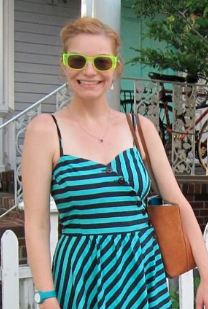
The week prior to this adventure, I took a trip to the Cambridge Antiques Market in search of some last minute wedding decor (my first time as maid of honor!). This place is amazing! I can't believe I've never been before especially since it's just down the street from my place. They have five floors full of fun stuff, all in good condition and reasonably priced. We were having so much fun (bride to be, Megan and I) looking at everything and squealing with delight. We were both smitten by a box of sassy Italian sunglasses, she picked up a purple pair (these became her "I'm freaking out and need to put on another persona" accessory) and I chose a neon lucite pair. I also snagged a luxurious leather purse, perfect for summer and made in Italy of course, as I was running out the door ($20 for the lot!).

Photo by Sophia Quach McCabe


Ready with my outfit, we put on Antonioni's Red Desert (1964).  


Screenshot from Red Desert.

The photography reminded me so much of Philadelphian artist Charles Sheeler (although Leger is said to be the inspiring artist).

Categorized as a Precisionist, Sheeler is known for flat panels of color and creating industrial atmospheres that give off a sense of religious expression. I am very drawn to his pictures. I like the juxtaposition of hard modern lines and dreamy environments.

Sheeler, Amoskeag Canal, 1948.

Monica Vitti.

Sheeler, Side of White Barn, 1915. Photograph.

Oh and Monica Vitti, amazing as always!


Sheeler, River Rouge Plant, 1932.
Sheeler, Architectural Cadences, 1954.